
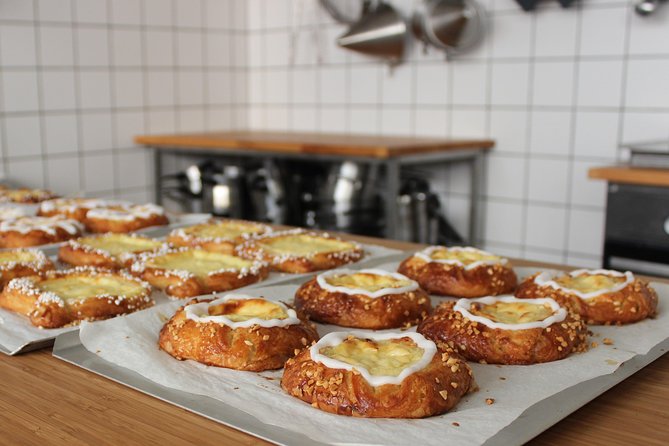
Review · DANISH PASTRY & SMORREBROD IN COPENHAGEN
The Art of Baking Danish Pastry
Bake Copenhagen into your morning. The Art of Baking Danish Pastry gives you hands-on instruction from Chef Frederik Terrible, plus a generous haul of pastries to enjoy later. I like the clear, practical teaching and the fact that you receive the recipes by email afterward, but you should plan for a lot of baked goods and bring a way to carry them.
The class takes place in Frederiksberg, west of central Copenhagen, and runs from 9:00 a.m. for about three and a half hours. That early start is useful: you can spend the afternoon sightseeing, shopping, or eating your way through the city. The main drawback is that the class moves at a brisk pace, and Frederik talks quickly when explaining each step, so you need to listen closely and ask questions as you work.
In This Review
- Key things to know before you book
- Why this pastry class is worth three and a half hours
- Reaching Frederiksberg for the 9:00 a.m. start
- Inside the Terrible French Pastry School
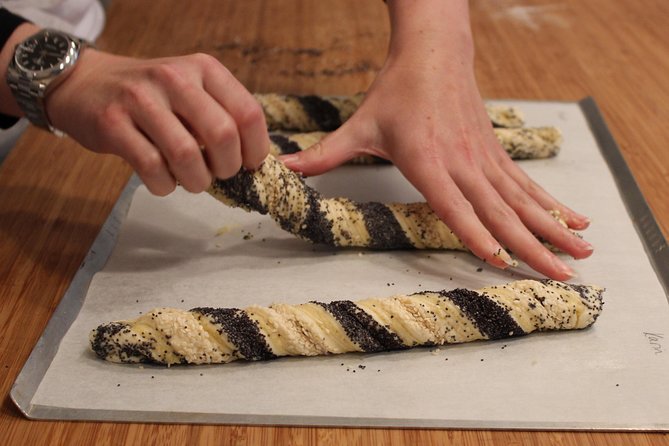
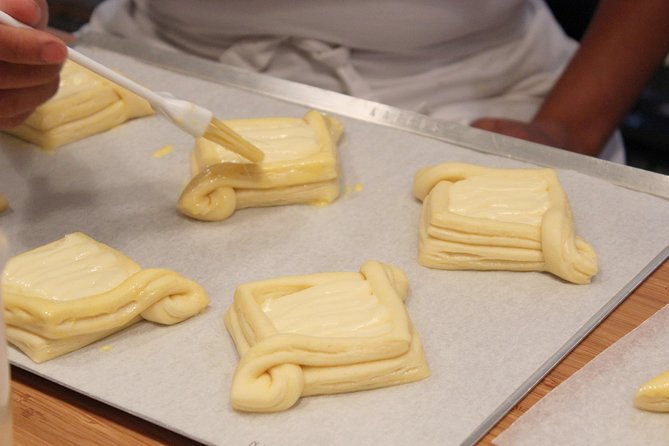
- The pastries you will make
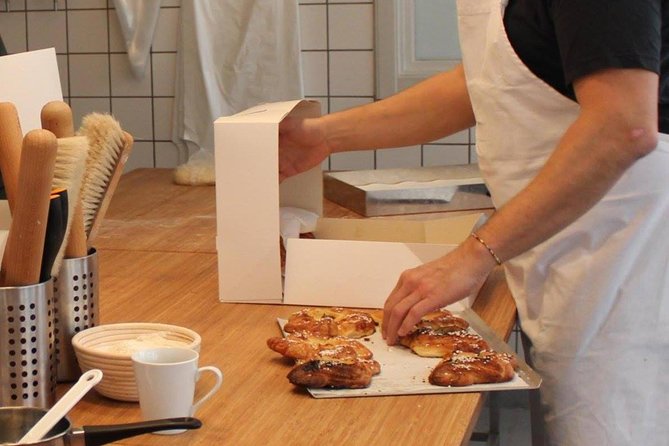
- Coffee, tasting, and the boxes you take home
- The recipes make the experience more useful
- Who will enjoy this Copenhagen activity most
- A closer look at the teaching style
- Is $117.23 a fair price?
- Should you book The Art of Baking Danish Pastry?
- FAQ
- Where does the Danish pastry class take place?
- What time does the class start?
- How long does the experience last?
- Is the class offered in English?
- How many people can join the class?
- Which pastries are included?
- Do I get to eat the pastries I make?
- Can I take pastries home?
- Are recipes provided after the class?
Key things to know before you book
- You make several pastries yourself, including cinnamon rolls, Spandauer, and poppy seed and sesame seed twists.
- Chef Frederik Terrible teaches the class, explaining kneading, rolling, folding, shaping, and filling.
- The group is capped at 12 people, giving the class a more personal feel than a large cooking demonstration.
- You may leave with around a dozen pastries or more per person, often enough to share with family and friends.
- Coffee and tea are served after baking, when you can taste what you have made.
- Recipes are emailed afterward, so the class continues after your Copenhagen visit.
Why this pastry class is worth three and a half hours
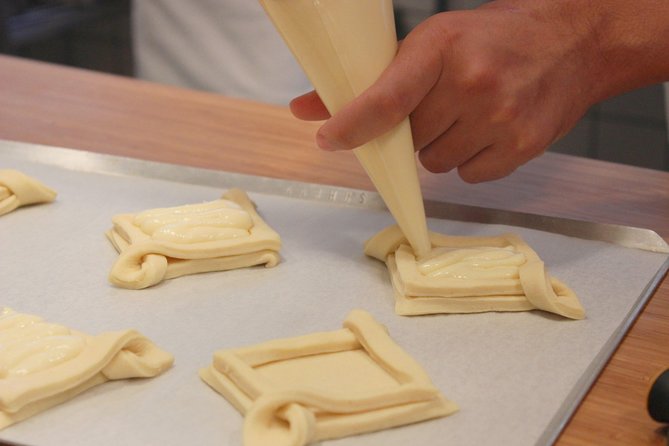
Danish pastry looks simple when it sits in a bakery case. The layers, fillings, twists, and glazes make it seem almost effortless. In practice, the dough requires care. You need to knead it properly, roll it evenly, fold it in the right way, and handle it without losing the structure that creates those flaky layers.
That is the real value of this class. You are not simply watching a baker prepare a pastry while you sample the result. You take part in the work. Frederik first demonstrates the methods, then guides you through the process as you make your own pastries.
I especially like this format for beginners. You do not need to arrive with advanced baking skills. The instructions are designed to take you through each stage, and Frederik checks on the group as you work. The teaching is described as patient, organized, funny, and firm, which is a useful combination in a class where a small mistake with dough can affect the final shape.
The class also avoids the usual problem of a cooking activity that gives you one tiny sample. You make a substantial amount of food. The exact quantity may vary, but you should expect far more than you can eat during the morning. Several people have described leaving with about a dozen pastries per person, while one group reported taking home 36 pastries per person.
That makes the experience feel less like a demonstration and more like a working pastry session. You learn, you bake, you taste, and you leave with something tangible.
Other pastry and smorrebrod tastings:
- Copenhagen: Best of Danish Pastry Tasting Tour
★ 4.8 · 414 reviews - Copenhagen: Danish Pastry Crawl with Private Guide
★ 4.9 · 46 reviews - Copenhagen Best of Danish Pastry Tasting Tour
★ 5.0 · 30 reviews
Reaching Frederiksberg for the 9:00 a.m. start
The meeting point is Grundtvigsvej 10A, 1864 Frederiksberg, Denmark. The area is west of Copenhagen’s city center and close to public transportation, but allow time to find the exact entrance.
A useful practical warning: the entrance may be around the other side of the street from where Apple Maps or Google Maps directs you. Give yourself extra time, especially because the class begins at 9:00 a.m. Arriving late does not necessarily ruin the morning, but the process moves quickly. One late participant was able to catch up, yet arriving on time is the better plan.
The activity ends back at the meeting point. There is no additional sightseeing stop or transfer afterward, so you are free to make your own plans for the rest of the day.
The small group size, with a maximum of 12 participants, matters here. Baking requires access to work surfaces, ingredients, and demonstrations. A large group would make it harder to see what is happening or get help when your dough needs attention. With fewer people, you have a better chance of asking a question while you are shaping or folding.
Inside the Terrible French Pastry School
The class takes place at the Terrible French Pastry School, the single stop on this experience. The name may suggest a formal professional school, but the class is suitable for first-time bakers as well as people who already know their way around a kitchen.
Frederik begins with the basic techniques. You learn how to knead the dough, roll it out, and fold it. These steps are the foundation of the morning, and they are also the part most likely to cause trouble if you rush.
The teaching is practical rather than abstract. You watch the demonstration, then repeat the process yourself. Frederik offers corrections and advice as the pastries take shape. The pace is active, with little wasted time, so you spend most of the three and a half hours doing something rather than sitting and listening.
That pace is a plus if you want a full activity. It is also the main challenge. Instructions can come quickly, especially when several steps happen close together. Keep your attention on the demonstration and ask for help as soon as you are unsure. Waiting until the dough is already shaped can make corrections harder.
The atmosphere sounds friendly, with humor mixed into the instruction. That helps take the pressure off beginners. You are learning a traditional baking skill, not sitting an exam.
The pastries you will make
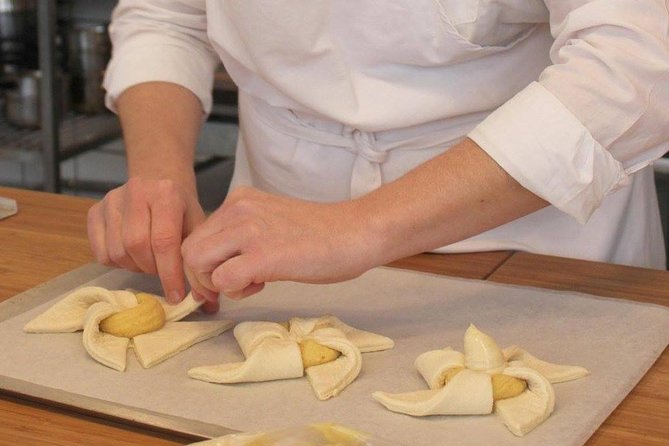
The sample menu includes three named pastries:
- Cinnamon rolls, or kanelsnegle
- Danish pastry, or Spandauer
- Poppy seed and sesame seed twists, or frøsnapper
Some class descriptions also refer to making four types of pastry, and the selection may shift during the year. That gives the experience some variety for repeat visitors, although you should treat the listed menu as a sample rather than a guarantee of every item served on your date.
The kanelsnegle is the familiar crowd-pleaser, with sweet cinnamon flavor and a soft, layered pastry base. It is an easy pastry to appreciate even if you have never baked before.
The Spandauer gives you a chance to work with a more classic Danish pastry shape. It shows how the dough, filling, and finished form come together in a way that looks distinctive in a bakery window.
The frøsnapper is likely to be the most memorable for many people. The poppy seed and sesame seed combination gives it a different flavor and texture from the cinnamon rolls. One especially popular version included marzipan, so anyone who likes almond flavor should pay close attention when this pastry appears in the class.
You will not simply assemble one of each. The class produces a large batch, which is why the take-home portion can become surprisingly generous. If you are visiting near the end of your trip, think carefully about how you will use the pastries. They are excellent for sharing, but you may not be able to eat them all yourself.
A few more Copenhagen outings worth comparing
- Copenhagen Card-Discover: 80+ Attractions & Public Transport
★ 4.6 · 5,351 reviews - Copenhagen: Hop-On Hop-Off Bus Tour with Boat Tour Option
★ 3.9 · 4,122 reviews - Private Walking Grand Tour of Copenhagen
★ 5.0 · 3,953 reviews - From Copenhagen: Lund and Malmö 2-Country Tour
★ 4.7 · 3,807 reviews
Coffee, tasting, and the boxes you take home
Once the pastries have finished baking, tea and coffee are served. This is a welcome pause after an active morning, and it gives you a chance to taste the results while they are fresh.
The tasting is part of the lesson. You can see how the texture turned out, compare the different pastries, and decide which recipes you want to repeat at home. It also adds a social element, since a small baking class naturally gives you time to talk with the other people at the worktables.
Do not plan a large breakfast immediately before the class. You will be surrounded by pastry for hours, and the finished quantity can be enormous. At the same time, do not assume that the tasting alone will replace lunch. The provided information confirms tea and coffee, but it does not promise a full meal.
You should also bring a practical plan for carrying the food. The class has been described as producing two full boxes of pastries for some participants. That is a wonderful souvenir, but an awkward one if you have a packed sightseeing schedule or are about to board a plane.
For this reason, I would book the class earlier in your Copenhagen stay if possible. You can enjoy the pastries over several days and share them with people you meet or with family and friends back home. Booking it on your final day can still work, but it may leave you trying to transport or give away more pastries than expected.
The recipes make the experience more useful

Many food activities end when you leave the kitchen. This one sends the recipes and instructions to you by email afterward. That is a major benefit because laminated dough and pastry shaping are skills that become easier with repetition.
The follow-up material also makes the $117.23 price easier to justify. You are paying for about three and a half hours of instruction, ingredients, equipment, tasting, and a substantial quantity of food. You also receive methods you can use at home rather than a souvenir that sits on a shelf.
The value is strongest if you enjoy cooking or want a food activity with a lasting result. If you only want to eat Danish pastry, a bakery crawl will cost less and take less time. If you want to understand how the pastry is made, practice the techniques, and leave with boxes of your own work, this class offers much more.
Who will enjoy this Copenhagen activity most
I would recommend the class to food lovers, curious beginners, couples, families with older children, and anyone looking for a break from museums and city sightseeing. It is also a good choice for people who enjoy meeting others in a small group.
You do not need to be a skilled baker. The instruction is step by step, and the preparation is organized to keep the group moving. An experienced home baker may still find value in Frederik’s techniques, alternative recipes, and advice about pastry handling.
The class is less suitable if you dislike early starts, cannot eat or carry a large quantity of pastry, or prefer a relaxed activity with long breaks. It is also not ideal for anyone who wants a broad tour of Copenhagen, since the focus stays firmly on baking.
The experience is offered in English. Confirmation is sent within 48 hours of booking, subject to availability. The activity requires a minimum number of participants, and if that minimum is not reached, you are offered another date or experience, or a full refund. The standard cancellation policy is strict: the booking is non-refundable and cannot be changed for any reason.
A closer look at the teaching style
The strongest part of the class is the instruction. Frederik is praised for being organized and clear, while also bringing enough humor to keep the morning light. He does not simply hand out ingredients and leave you to guess what comes next.
That matters with pastry. Beginners often need help judging dough, shaping pieces, or following a sequence of folds. Frederik’s habit of walking around and checking each person’s progress gives you a chance to correct problems before the pastries go into the oven.
Still, you need to take responsibility for keeping up. The class is fast enough that daydreaming can cost you a step. I would stand where you can see the demonstration, listen carefully when the next instruction begins, and ask questions during the shaping stage rather than trying to fix things later.
The tone appears to balance precision and fun. Frederik is described as funny but firm, which is useful when a recipe requires a specific technique. You get a social morning, but the class does not lose sight of the baking.
Is $117.23 a fair price?
At $117.23 per person, this is not a cheap breakfast. The price makes sense if you count the full package: a small English-language class, professional instruction, ingredients, several pastry types, coffee and tea, tasting, take-home food, and recipes for later use.
The amount of pastry is a particularly important part of the value. You may leave with enough to share with a family or vacation group. Some people even gave part of their batch away because there was simply too much to eat.
The value is weaker if you are traveling alone and have no interest in baking after the class. In that case, a visit to a Copenhagen bakery will be cheaper and simpler. You are paying here for the process, not just the food.
The experience is often booked around 70 days in advance, so popular dates may disappear well before your visit. If the class fits your plans, reserving early is sensible. Just remember the strict cancellation terms before paying.
Should you book The Art of Baking Danish Pastry?
Yes, if you want an active food experience and like the idea of taking Danish baking skills home with you. The small group, careful instruction from Frederik Terrible, generous pastry output, and emailed recipes make this more than a quick tasting.
Book it near the start or middle of your Copenhagen stay if you can. That gives you time to enjoy the pastries instead of trying to transport them on departure day. Arrive early, check the entrance carefully, and come ready to listen closely.
Skip it if you want a short, inexpensive food stop or if three and a half hours of hands-on baking sounds tiring. For everyone else, this is a warm, practical, and delicious way to spend a Copenhagen morning.
FAQ
Where does the Danish pastry class take place?
The class takes place at the Terrible French Pastry School, at Grundtvigsvej 10A, 1864 Frederiksberg, Denmark.
What time does the class start?
The class starts at 9:00 a.m.
How long does the experience last?
The experience lasts approximately three hours and 30 minutes.
Is the class offered in English?
Yes. The activity is offered in English.
How many people can join the class?
The class has a maximum of 12 participants.
Which pastries are included?
The sample menu includes cinnamon rolls, called kanelsnegle, Spandauer Danish pastry, and poppy seed and sesame seed twists, called frøsnapper. The pastry selection may change during the year.
Do I get to eat the pastries I make?
Yes. After the pastries bake, tea and coffee are served, and you can taste your finished pastries.
Can I take pastries home?
Yes. The class produces a large quantity of pastries, and participants can box them to take away.
Are recipes provided after the class?
Yes. The recipes used during the class are emailed to you afterward.
Newest around Copenhagen
- WWII Copenhagen Nyhavn and War Museum Private Walking Tour★ 5.0 · 2 reviews
- Half Day Exploration of Helsingør and Kronborg★ 3.5 · 3 reviews
- Helsingør Castle and Historic City Self-Guided Walking Tour★ 4.0 · 4 reviews
- Full-Day Tour; Castle, Palace & Cathedral, Winter(JAN-MAR)★ 5.0 · 11 reviews
- walking tour – Copenhagen and Christiansborg 3 hours★ 4.0 · 7 reviews
- Copenhagen Walking Tour with Food Testing (smorrebrod dish & snap)★ 4.5 · 10 reviews
- The Philosopher’s Last Walk: An audio tour on the life of Søren Kierkegaard★ 4.5 · 5 reviews
- The Forgotten Giants Private Tour★ 5.0 · 3 reviews
Danish Pastry & Smorrebrod, compared.

Copenhagen Walking Tour with Food Testing (smorrebrod dish & snap)
Read our review →Browse the lists this tour appears in