Review · WORKSHOPS
Copenhagen (2-Hour Paper Marbling Workshop with Goda)
Small paper, big creative surprise. In a quiet artist studio in Nørrebro, you learn an old printmaking craft, make several colorful sheets, and take your work home. I like the tiny group size, limited to three people, and the fact that designer and traveler Goda leads the session herself. I also like that this is a souvenir you create, not something pulled from a gift shop shelf.
The main consideration is timing. Your prints need to dry before you can pack them properly, so this workshop works best early in your Copenhagen stay. At $110 per person for 150 minutes, it is not a bargain basement activity, but the personal instruction, materials, drinks, and several handmade prints give the price real weight.
In This Review
- Key points at a glance
- Arriving at BLADR in Nørrebro
- Why marbling makes such a good Copenhagen souvenir
- How the 150-minute workshop unfolds
- Learning the floating surface
- Building the pattern
- Lifting the paper
- Tea, coffee, and drying time
- What is included for the $110 price
- The small group changes the whole mood
- Practical planning before you book
- Who will enjoy this most
- Should you book Goda’s paper marbling workshop?
- FAQ
- Where does the paper marbling workshop take place?
- How long does the workshop last?
- How many people can join the workshop?
- Which languages are available?
- Are the workshop materials included?
- Can I take my own marbled papers home?
- Is sending the finished prints included?
- How far in advance can I cancel for a full refund?
Key points at a glance
- A three-person maximum: The small group keeps the workshop personal and gives you room to work without waiting long for help.
- A 1,000-year-old craft: Paper marbling began in Japan, then traveled through Persia and Turkey before reaching Europe.
- Your prints are truly one of a kind: Each design forms on a floating bath, so no two sheets come out exactly alike.
- A local Nørrebro setting: The class takes place inside BLADR, an artist bookstore at Griffenfeldsgade 27.
- Everything is supplied: You get prepared colors, paper, a carrageenan bath, an apron, tea, and coffee.
- Plan around drying time: Book at least one or two days before departure if you want the best chance of receiving dry, travel-ready prints.
Arriving at BLADR in Nørrebro
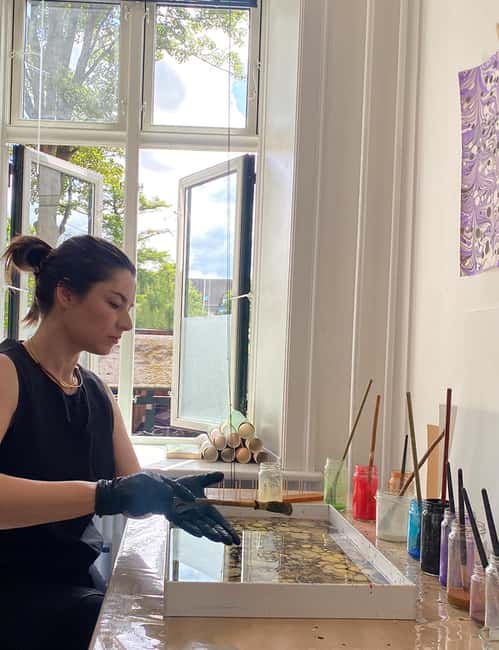
The workshop takes place inside BLADR, an artist bookstore at Griffenfeldsgade 27. That setting gives the activity a more personal feel than a large craft center or a standard sightseeing stop. You are entering a working creative space, not simply sitting down for a packaged tourist demonstration.
The class welcomes solo participants and small parties of two or three. That matters because paper marbling involves hands-on steps, and you will want enough attention when you begin moving paint across the liquid surface. With only three participants at most, Goda can explain the tools, watch your technique, and answer questions without turning the session into a lecture.
The atmosphere is described as private and relaxed. I would choose this for a quieter part of your Copenhagen schedule, especially after a day of museums or city walking. The work asks you to slow down and watch what happens in front of you. There is no need to rush from one sight to the next.
The instruction is available in English and Danish. That makes the workshop practical for international visitors, while still giving it a local connection. Goda’s background as a designer and traveler also fits the activity well. She is not simply presenting a craft from a script. The session is shaped around making, experimenting, and helping you understand why the patterns behave as they do.
A few more Copenhagen outings worth comparing
- Copenhagen Photography Masterclass – Private Photography Lesson
★ 5.0 · 5 reviews - Private Photography Workshop in Copenhagen
★ 5.0 · 3 reviews - Copenhagen: Photography Masterclass – Private Photo Lesson
★ 5.0 · 2 reviews
Why marbling makes such a good Copenhagen souvenir
Most city souvenirs are easy to buy and easy to forget. A paper marbling workshop gives you something with a clear connection to your time in Copenhagen: you made it there, during a small creative session, with every swirl formed by your own choices and a bit of chance.
Marbled paper has been used for precious documents, album covers, book endpapers, and furniture decoration. The method has a long route behind it. It was practiced in Japan about 1,000 years ago, then spread to Persia and Turkey. Travelers helped carry it into Europe, which makes the craft especially fitting for a city visit.
The finished sheets are light and easy to display. You might frame one, use another as a colorful cover, or keep the group together as a record of your trip. The activity produces more than one piece, so the $110 cost does not rest on a single small souvenir.
The strongest part is the uncertainty. You can guide the paint, but you cannot fully control the result. That leaves each sheet with its own pattern. If you prefer exact, repeatable artwork, this may feel loose. If you enjoy seeing a design develop through small decisions and happy accidents, the process is likely to hold your attention.
How the 150-minute workshop unfolds
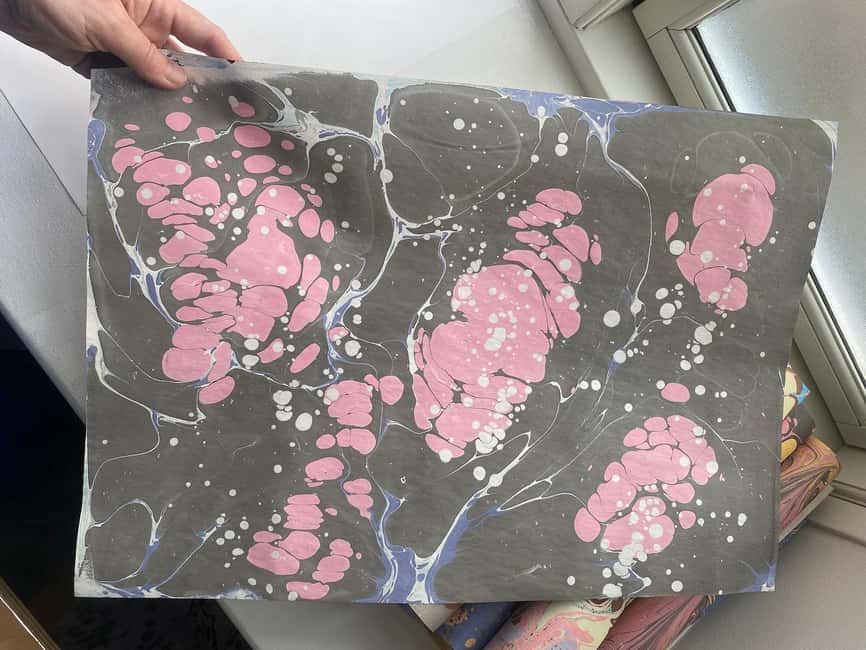
The full session lasts about 150 minutes, or two and a half hours. The time allows you to learn the method, make your own sheets, and have a drink while the papers dry.
Learning the floating surface
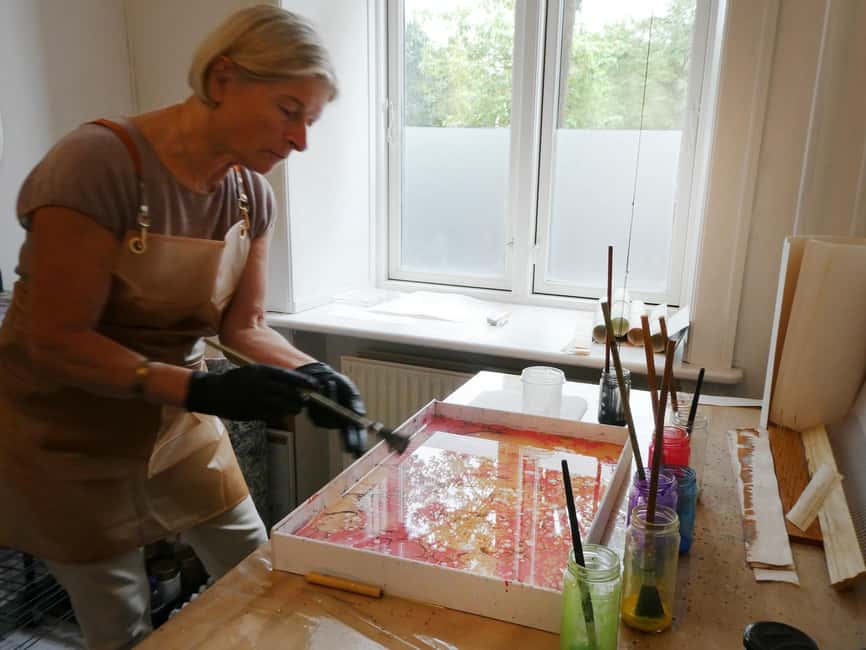
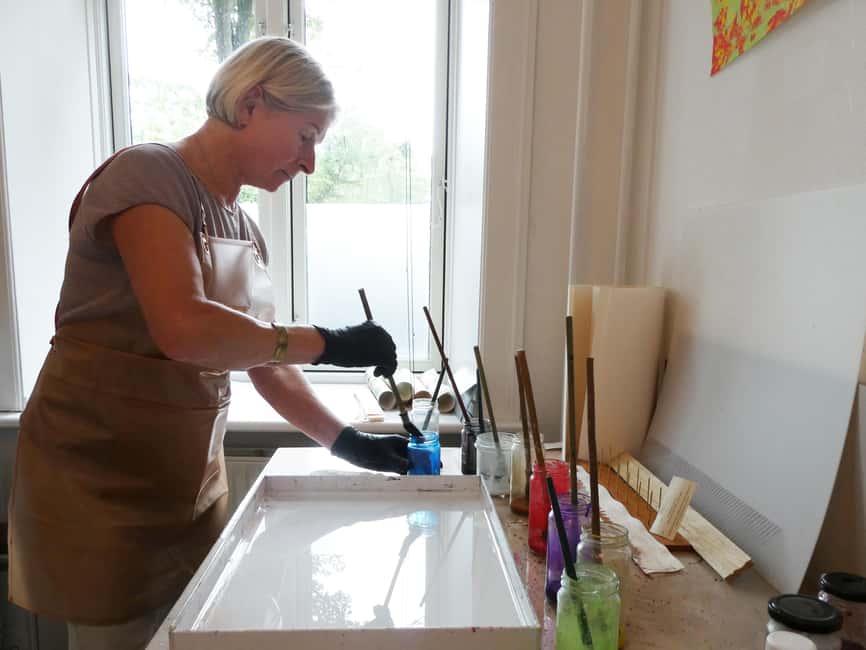
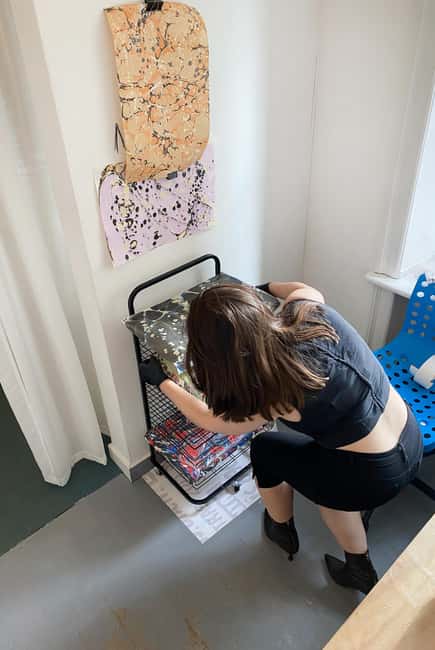
The process begins with the size, a prepared liquid surface made by mixing water with carrageenan powder. Paint does not simply sit on ordinary water in the same way. The thickened bath gives the color a surface where it can spread and respond to your tools.
The carrageenan bath is prepared before you arrive. That is a useful detail because it leaves your time for the creative work instead of spending much of the class on setup. Pre-mixed colors are also included, along with pre-cut sheets of paper.
You will get familiar with the traditional tools and the gestures used to move paint. Those gestures shape the patterns. A small movement can pull color into lines, curves, or more open forms. The point is not to reproduce one exact image. It is to see how color and motion interact.
Somewhere else in Denmark, for a completely different day:
- Copenhagen Card-Discover: 80+ Attractions & Public Transport
★ 4.6 · 5,351 reviews - Copenhagen: Hop-On Hop-Off Bus Tour with Boat Tour Option
★ 3.9 · 4,122 reviews - Private Walking Grand Tour of Copenhagen
★ 5.0 · 3,953 reviews - From Copenhagen: Lund and Malmö 2-Country Tour
★ 4.7 · 3,807 reviews
Building the pattern
Once the colors are placed on the floating surface, you can work them into different movements. The colors interact, and the surface responds in ways that are not fully predictable. This is where the activity becomes more than a simple painting class.
I like that you can experiment without needing advanced art skills. You are learning a set of basic actions, then watching the surface answer back. Your first print may teach you more than a long explanation because you can see how one gesture changes the result.
The colors also affect one another. A bold shade can pull attention across the page, while a quieter color may soften the overall design. Since every print develops differently, you have a reason to keep trying rather than stopping after one sheet.
Lifting the paper
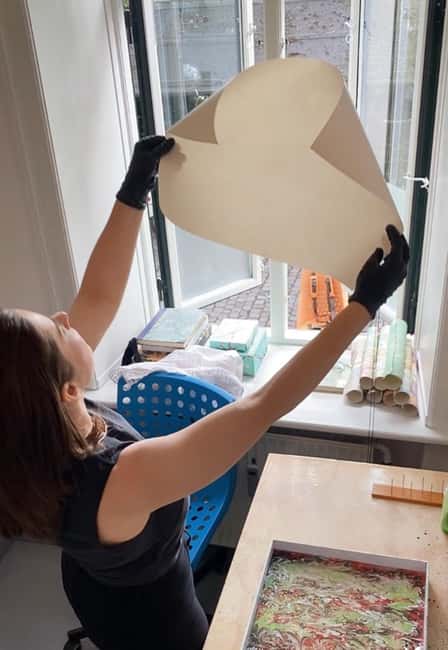
When the pattern is ready, you place a sheet of paper on top of the floating paint. You then lift it away to reveal the image transferred onto the paper.
This reveal is the small thrill at the heart of the workshop. You can make choices beforehand, but the finished sheet still holds some surprise. The print is not a perfect copy of a design you planned on a flat surface. It records the movement of the paint and the timing of the lift.
You will be able to make your own prints and bring them home. The supplied feedback describes people producing several beautiful pieces, rather than leaving with only one sample. The exact number is not specified, so I would think of the output as a small collection rather than promise a fixed quantity.
Tea, coffee, and drying time
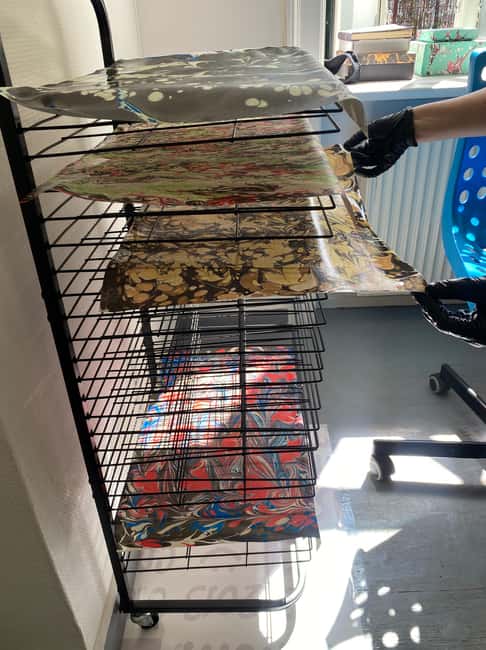
After the active part of the class, the papers need time to dry. Tea and coffee are served while you wait. One account also describes a small snack and a hot drink, though the listed inclusions specifically confirm tea and coffee.
This pause is useful rather than wasted time. It gives you a chance to look over the different patterns, compare the results, and let the session end at an easy pace. The activity is calming partly because it includes this natural break.
Drying is the practical issue to plan around. One visitor who was leaving the next day received special help getting the prints delivered, even in snowy weather. Another had the papers dried, ironed, packaged for the journey, and delivered to a hotel. Treat that as a kind gesture rather than a standard service, since sending prints is not included in the price.
For your own plans, book at least one or two days before leaving Copenhagen. That gives the papers time to fully dry. If you are flying home immediately after the workshop, ask about the handover before you book and do not assume delivery is guaranteed.
What is included for the $110 price
The cost is $110 per person. That is a substantial price for a two-and-a-half-hour activity, so it deserves a careful look.
You are paying for a very small class, direct instruction from Goda, and a private studio setting. All core materials are covered:
- Pre-mixed colors
- Pre-cut paper sheets
- A prepared carrageenan bath
- An apron
- Tea and coffee
The prepared bath and colors are more important than they might first appear. You do not need to buy supplies, mix the liquid, or figure out how to prepare the paint before you can begin. The session puts its emphasis on learning the craft and making prints.
The price also includes the chance to take home multiple pieces of work. If you value hands-on activities and personal instruction, that makes the cost easier to justify. If you mainly want a low-cost souvenir, buying a finished sheet would likely be cheaper and faster.
There is no listed shipping service. You should also remember that the class takes 150 minutes, plus whatever time is needed to arrange the dry papers afterward. This is a planned activity, not a quick stop you can squeeze between two timed museum visits.
The small group changes the whole mood
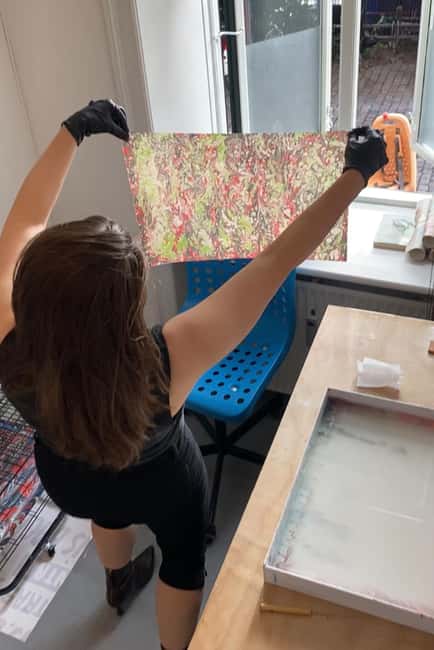
A group limit of three is one of the best features here. In a larger class, you might spend much of the session watching someone else use the tools. In this format, each participant has a better chance to try the process repeatedly and ask for help when a pattern does not behave as expected.
The small setting also suits people who are unsure about art classes. You do not need to arrive as a practiced artist. The activity is designed around traditional tools, simple gestures, color movement, and the natural uncertainty of the medium.
Solo visitors may appreciate the calm setting. Couples, parents with an older child, and friends traveling together can make the activity their own without being lost in a large crowd. A parent and daughter found it especially meaningful as a shared Copenhagen memory, which makes sense: the finished prints become reminders of time spent making something together.
The workshop may be less suitable if you want a fast, highly structured demonstration with a guaranteed visual result. The charm comes from the unpredictable patterns, so part of the fun is giving up complete control.
Practical planning before you book
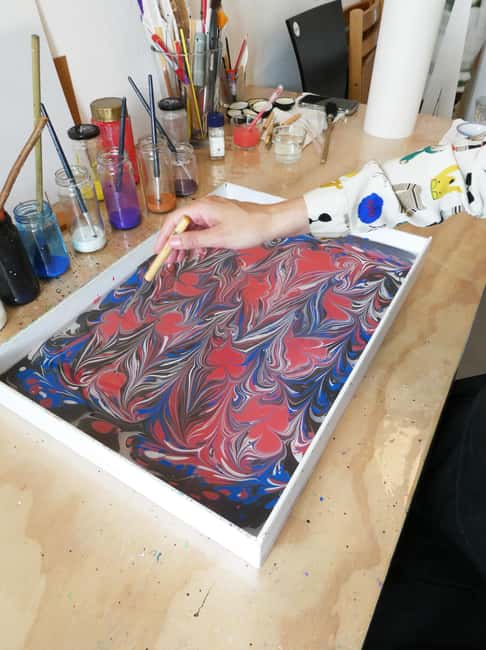
Set aside the full 150 minutes. Do not schedule a major appointment immediately afterward, since the pace includes teaching, several prints, and drying time.
Choose an early or middle date in your stay rather than the final day. The best advice is to leave one or two days before departure for the papers to dry. This is especially important if you want to frame the work, keep the sheets flat, or avoid carrying damp paper in your luggage.
The meeting point is inside BLADR at Griffenfeldsgade 27 in Nørrebro. Make sure you go to the bookstore itself, since the workshop is not described as taking place in a separate street-front studio.
You can book and pay later, which helps if your Copenhagen schedule is still changing. Free cancellation is available up to 24 hours in advance for a full refund. Check the available start times when choosing your date, as the duration is fixed but the starting schedule can vary.
The activity is offered in English and Danish. All materials are included, so you do not need to bring paper, paint, or tools. Sending the finished prints is not included, and any special delivery arrangement should be confirmed directly rather than assumed.
Who will enjoy this most
I would recommend this workshop to:
- Art lovers who want to learn a traditional technique
- Visitors looking for a handmade Copenhagen souvenir
- Solo participants who prefer a quiet, personal activity
- Couples or family members who want to create something together
- Anyone who needs a peaceful break from sightseeing
- Creative people who enjoy designs shaped partly by chance
It is also a good choice for someone who says they are not artistic but wants to try something new. The process gives you clear tools and movements, while the floating paint keeps the final result open.
I would be more cautious about recommending it to visitors with only a few hours in the city, anyone leaving Copenhagen immediately afterward, or people who want a fixed number of finished prints in a guaranteed style. The activity rewards patience and curiosity more than speed.
Should you book Goda’s paper marbling workshop?
Book it if you want a personal, creative Copenhagen memory and you can spare two and a half hours in Nørrebro. The strongest reasons are the three-person limit, Goda’s direct guidance, the artistic setting inside BLADR, and the fact that you leave with prints you made yourself.
The $110 price is fair for travelers who value instruction and several handmade pieces, though it will feel high if you only want a cheap keepsake. Schedule it at least one or two days before your flight, and confirm how you will receive the dried papers.
For art lovers, curious beginners, and anyone tired of collecting ordinary souvenirs, this is a thoughtful choice. You leave with paper, but the better souvenir is the memory of watching color float, shift, and become something you could not have planned exactly.
FAQ
Where does the paper marbling workshop take place?
It takes place inside the artist bookstore BLADR at Griffenfeldsgade 27 in Nørrebro, in Copenhagen.
How long does the workshop last?
The workshop lasts 150 minutes, or about two and a half hours.
How many people can join the workshop?
The group is limited to three participants. Single participants and groups of two or three are welcome.
Which languages are available?
Instruction is available in English and Danish.
Are the workshop materials included?
Yes. The inclusions are pre-mixed colors, pre-cut paper sheets, a prepared carrageenan bath, an apron, tea, and coffee.
Can I take my own marbled papers home?
Yes. You can make your own prints during the workshop and bring them home.
Is sending the finished prints included?
No. Sending the prints is not included.
How far in advance can I cancel for a full refund?
You can cancel up to 24 hours in advance for a full refund.
More 2-Hour Experiences in Copenhagen
- Copenhagen: Group Walking Tour – City Highlights – 2 Hours
★ 4.7 · 1,088 reviews - Copenhagen: 2-hour City Highlights Bike Tour
★ 4.7 · 632 reviews - Segway Tours Copenhagen w. Guide & Concierge Service. 2 Hours+
★ 5.0 · 550 reviews - 2 Hour Copenhagen Segway Tour
★ 5.0 · 404 reviews
Newest around Copenhagen
- WWII Copenhagen Nyhavn and War Museum Private Walking Tour★ 5.0 · 2 reviews
- Half Day Exploration of Helsingør and Kronborg★ 3.5 · 3 reviews
- Helsingør Castle and Historic City Self-Guided Walking Tour★ 4.0 · 4 reviews
- Full-Day Tour; Castle, Palace & Cathedral, Winter(JAN-MAR)★ 5.0 · 11 reviews
- walking tour – Copenhagen and Christiansborg 3 hours★ 4.0 · 7 reviews
- Copenhagen Walking Tour with Food Testing (smorrebrod dish & snap)★ 4.5 · 10 reviews
- The Philosopher’s Last Walk: An audio tour on the life of Søren Kierkegaard★ 4.5 · 5 reviews
- The Forgotten Giants Private Tour★ 5.0 · 3 reviews
Workshops, compared.
Copenhagen Photography Masterclass – Private Photography Lesson
Read our review →